Tag: future of work

  • The Rise of Remote Work Hubs in the UK

    The Rise of Remote Work Hubs in the UK

    The way Britain works has changed for good, and at the centre of this quiet revolution sit remote work hubs. No longer a niche experiment, they are rapidly becoming a permanent fixture of the professional landscape, reshaping cities, suburbs and rural communities alike.

    What are remote work hubs and why are they booming?

    Remote work hubs are shared spaces designed for professionals who do not need, or want, to commute to a central office every day. They usually offer high speed connectivity, bookable desks and meeting rooms, and a level of polish that makes working from home in pyjamas feel faintly embarrassing.

    The boom is driven by a convergence of forces: employers trimming expensive office footprints, professionals refusing to surrender the flexibility they gained, and local councils eager to revive high streets with a new daily footfall. The result is a patchwork of sleek city centre spaces, suburban studios above shops, and rural barns quietly humming with video calls.

    How remote work hubs are reshaping UK working life

    The influence of remote work hubs extends far beyond a convenient desk. They are subtly rewiring how and where we live, shop and build careers.

    In city centres, hubs have softened the blow of reduced corporate office space. Instead of five days a week in one headquarters, professionals now split their time between occasional trips to town and two or three days in a well equipped local hub. Cafes, independent retailers and fitness studios feel the benefit of this more evenly distributed weekday trade.

    In commuter belts, the impact is even starker. Areas once emptied each morning are now busy from nine to five, as residents choose a ten minute walk to a hub over an hour on a train. Formerly sleepy parades are seeing new life: a craft bakery here, a smart wine bar there, all supported by steady custom from laptop wielding regulars.

    From kitchen table to curated community

    For many professionals, the appeal of remote work hubs is social as much as practical. The novelty of the kitchen table wore off quickly, replaced by isolation, blurred boundaries and a creeping sense that careers might stall out of sight and out of mind.

    Well run hubs answer that with curated events, informal introductions and a gentle sense of occasion. A Tuesday breakfast talk with a visiting founder, a Thursday afternoon legal clinic, a monthly showcase of local start ups – all of it designed to ensure members feel plugged into something larger than their own to do list.

    It is in this space that operators like R2G have carved out a niche, positioning hubs not simply as desk providers, but as conveners of talent across sectors and stages. The most successful venues now feel closer to private members clubs for the professionally restless than to traditional serviced offices.

    What professionals should look for in remote work hubs

    With choice expanding rapidly, professionals can afford to be discerning. Location still matters, but it is no longer the only deciding factor. Look carefully at the mix of members, the quality of meeting spaces, and the clarity of policies around quiet zones and phone booths.

    Membership flexibility is crucial. Many people now blend office days, hub days and home days, so rigid long term contracts feel out of step. The better hubs offer tiered options, from a few days a month to full time access, often with the ability to pause or shift as life changes.

    Culture is harder to quantify, but you will feel it quickly. Are staff present and attentive without being intrusive? Do members greet each other, or sit in tense silence? Is there an atmosphere of focus rather than performance? These subtleties often matter more than the coffee machine, however lovingly described in the brochure.

    The future of these solutions in the UK

    The next phase of growth is likely to be more targeted. Rather than generic spaces, we are already seeing specialist these solutions for creatives, for climate focused ventures, and for professional services firms seeking neutral ground for clients.
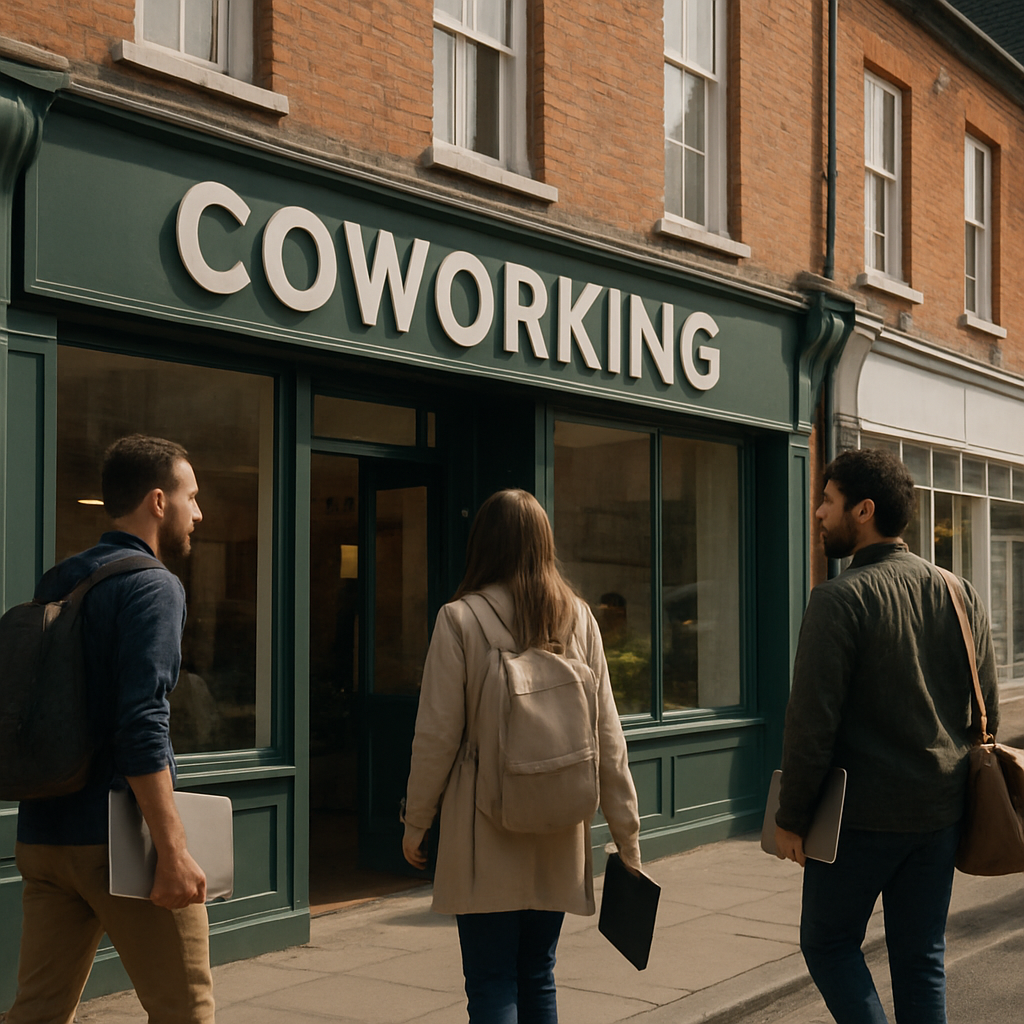

    Suburban coworking space on a UK high street illustrating the growth of remote work hubs
    Team in a meeting room inside one of the UK’s remote work hubs

    Remote work hubs FAQs

    What are remote work hubs in practical terms?

    Remote work hubs are shared workspaces where individuals and small teams can rent desks, offices or meeting rooms on flexible terms. They offer professional grade internet, printing, call booths and communal areas, providing a structured alternative to working from home or commuting to a central office every day.

    Who benefits most from using remote work hubs?

    Professionals with hybrid working arrangements, freelancers, consultants and small businesses gain the most from remote work hubs. They get a professional environment, networking opportunities and a clear boundary between work and home, without the long term costs and commitments of a private office lease.

    How do I choose the right remote work hub for me?

    Start with location and travel time, then visit a few hubs to compare atmosphere, facilities and membership flexibility. Look for reliable connectivity, quiet areas for calls, well maintained meeting rooms and a member community that feels aligned with your own work and expectations of professionalism.


  • How AI is Quietly Rewriting Office Life

    How AI is Quietly Rewriting Office Life

    AI in the workplace has moved from experiment to everyday reality, often without the fanfare one might expect. The most striking change is that it is no longer confined to specialist teams. It is quietly embedded in calendars, inboxes and HR systems, reshaping how decisions are made and how work feels.

    What AI in the workplace actually looks like now

    For most professionals, the first encounter with this technology is unglamorous: meeting transcripts that appear automatically, suggested email replies, and scheduling tools that anticipate preferences. These small frictions being removed at scale can alter the rhythm of an entire organisation.

    In many offices, AI tools are starting to summarise lengthy reports, flag anomalies in spreadsheets and even draft the first version of client presentations. Rather than replacing roles outright, they are shaving hours from the more mechanical parts of the day, allowing people to focus on interpretation, judgement and relationships.

    Behind the scenes, finance teams are using predictive models to forecast cash flow with greater precision, while operations teams lean on algorithms to spot bottlenecks before they become visible to the human eye. The effect is subtle but profound: fewer surprises, more data and a constant pressure to justify decisions.

    How AI in the workplace is reshaping meetings and communication

    Meetings are often the most visible frontier. Automatic transcription, real-time translation and live action points are becoming standard in larger firms. A quiet revolution is under way: the focus is shifting from note-taking to genuine discussion.

    When every word is recorded and converted into searchable text, the culture of meetings changes. It becomes harder to rely on vague recollections or informal agreements. Clarity improves, but so does the sense of scrutiny. Leaders need to think carefully about when such tools are appropriate, and when a conversation should remain off the record.

    Internal communication platforms are also being reshaped. AI-driven assistants are fielding routine HR questions, guiding staff through policies and even suggesting learning resources based on role and performance. The line between knowledge base and colleague is becoming blurred.

    Ethics, bias and trust in AI in the workplace

    The ethical questions are no longer theoretical. Recruitment platforms can scan thousands of CVs in minutes, but they can also entrench bias if they learn from historical hiring data. Performance tools can flag underperformance early, yet risk reducing complex human stories to a single score.

    Trust is now a strategic asset. Employees increasingly want to know which decisions are being influenced by algorithms, what data is being collected and how it is being used. Clear governance, transparent policies and the ability to contest automated decisions are fast becoming minimum expectations rather than luxuries.

    Forward-looking organisations are involving staff in the design and rollout of new systems, inviting feedback and stress-testing tools before they touch sensitive processes such as promotion or pay. The aim is to use AI as a decision support layer, not an unquestioned authority.

    Preparing people and processes for the next wave

    The most successful adopters treat AI as an organisational capability rather than a gadget. That means investing in training, redesigning workflows and setting clear boundaries on where automation stops. It also means accepting that some roles will evolve significantly.

    Professionals are being nudged towards new skill sets: data literacy, critical thinking, prompt crafting, and a more rigorous approach to checking sources. The value of domain expertise is rising, not falling, as staff are asked to interpret machine-generated outputs and push back when something feels wrong.

    Specialist consultancies such as ACS are increasingly being asked to audit existing tools, map out where automation genuinely helps, and where it simply adds complexity. The emphasis is on building quiet, dependable systems rather than headline-grabbing experiments.

    What leaders should do now

    For leaders, the task is to set a thoughtful pace. That starts with a clear view of where AI genuinely supports the organisation’s goals, rather than adopting tools because competitors have done so. Pilots should be small, measurable and reversible.

    Open-plan office where staff interact with data dashboards driven by AI in the workplace
    <a href=Business leader discussing strategy using analytics from AI in the workplace” style=”display:block;width:100%;height:auto;max-width:1000px;margin:0 auto;”>

    AI in the workplace FAQs

    Will AI in the workplace replace my job entirely?

    Most current deployments of AI in the workplace focus on automating specific tasks rather than whole roles. Routine, repetitive work is likely to change the most, while activities involving judgement, relationships and creativity remain firmly human. Roles will evolve, with more emphasis on overseeing, interpreting and challenging machine-generated outputs.

    How can companies introduce AI in the workplace without losing employee trust?

    Trust depends on transparency and participation. Organisations should be clear about what tools are being used, what data they rely on and which decisions they influence. Involving staff in pilots, inviting feedback and offering training all help. Crucially, employees should retain the right to question or appeal outcomes that rely heavily on automated systems.

    What skills should I develop to stay relevant as AI in the workplace grows?

    It is useful to build confidence with data, learn how to structure good questions for AI tools and strengthen critical thinking. Domain expertise remains vital, as does the ability to communicate clearly and work with others. Those who can combine technical fluency with sound judgement and ethical awareness will be particularly well placed.