
There is a fire station in a market town in Shropshire that has been without a full crew for eleven months. The appliance sits there, polished and ready, but on any given weekday afternoon there are not enough retained firefighters available to take it out safely. This is not an anomaly. It is, I’m afraid, the texture of ordinary life across vast stretches of rural Britain in 2026, and the people responsible for fixing it have not yet managed to explain why they haven’t.
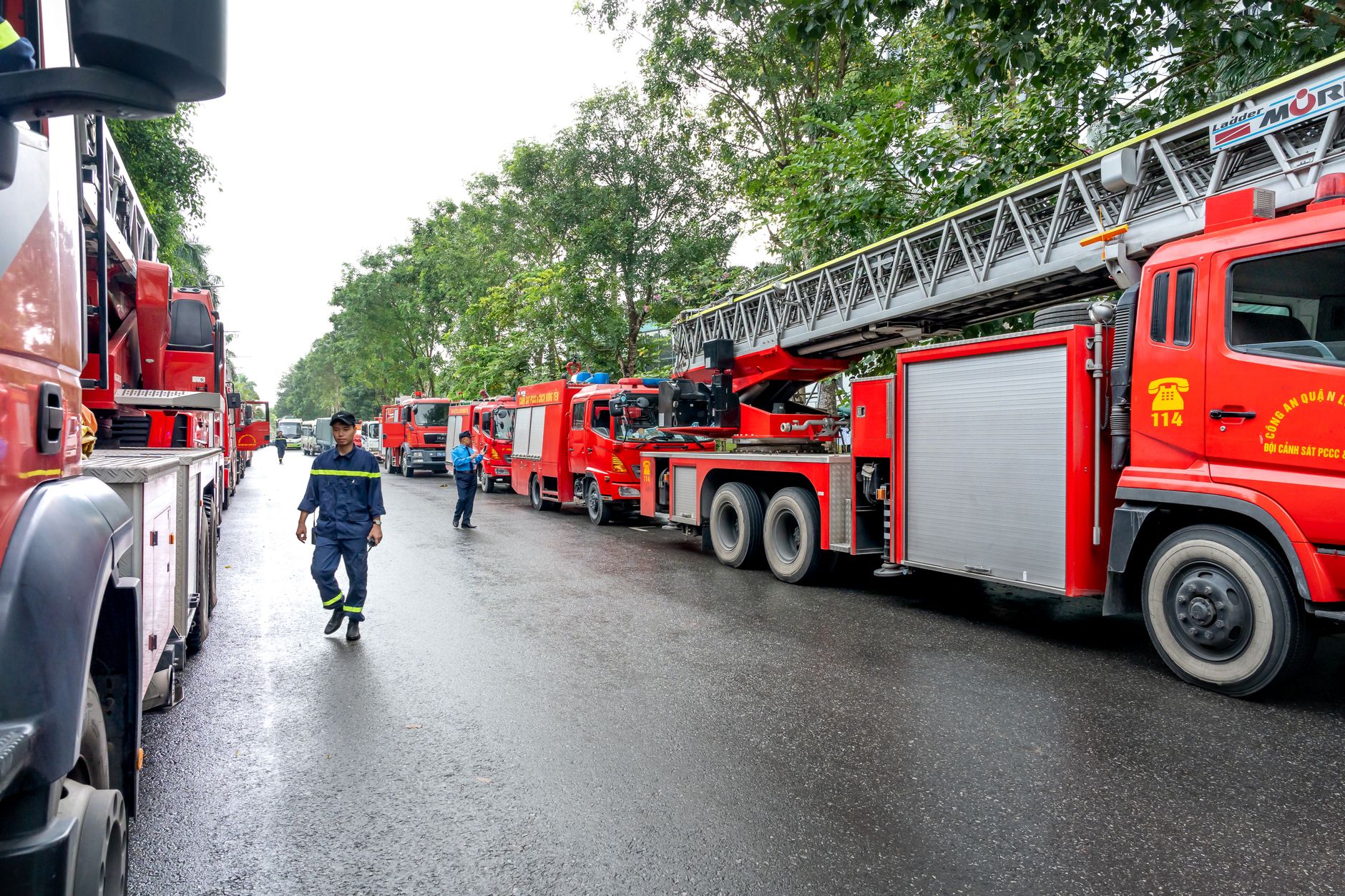
Retained firefighters, also called on-call firefighters, are the backbone of fire and rescue cover outside Britain’s cities. According to the Home Office’s own workforce statistics, on-call staff make up roughly 36 per cent of the total fire and rescue workforce in England. In Scotland and Wales, the proportions in rural areas are higher still. Strip them out and you lose coverage for somewhere between 60 and 70 per cent of the country’s landmass. That is not a footnote. That is a structural fact.
Why the numbers are collapsing
The retained firefighters crisis did not arrive suddenly. It has been building for a decade, driven by a set of economic and social changes that interact badly with the specific demands of on-call service. To respond to a shout, a retained firefighter must be able to reach their station within a set time, typically four minutes. In a world where employment has concentrated in towns and cities, where broadband has still not reached many villages, and where the cost of housing has pushed younger workers further from rural centres, the pool of people who live or work close enough to a rural station has been quietly shrinking.
Then there is the employer problem. Retained firefighters are not employed full-time by their fire service; they are paid a retaining fee and a turnout fee per incident. Their primary employer, if they have one, must be willing to release them at short notice. Increasingly, employers are not. The gig economy, zero-hours contracts, and the general erosion of workplace flexibility have made it functionally impossible for many workers to commit to on-call duties. I spoke to one retained crew manager in mid-Wales who told me he had lost four of his best people in eighteen months, not because they lost interest but because their employers simply refused to accommodate the interruptions.
What underfunding actually looks like on the ground
Fire and rescue authorities in England have faced cumulative real-terms funding cuts of around 30 per cent since 2010, according to the Local Government Association. The headline number obscures what that means operationally. It means recruitment campaigns that never launch because there is no budget. It means training programmes that are delayed or shortened. It means the retention payment, which has not risen meaningfully in years, failing to keep pace with what people can earn in any number of other flexible roles.

In Scotland, His Majesty’s Fire Service Inspectorate Scotland has flagged concerns about on-call availability repeatedly since 2021. The Scottish Fire and Rescue Service has stations in the Highlands where daytime crew availability falls below the minimum safe threshold several days each month. The service is aware of this. The Scottish Government is aware of this. The response, so far, has been a series of working groups and consultation documents that have produced very little of practical consequence.
Rural communities have not sat passively through this. Across England, Scotland and Wales, volunteer-led efforts to raise local awareness and keep fire stations visible in community life have proliferated. Parish councils hold fundraising nights. Local businesses sponsor open days. Christmas events, charity auctions, and community fairs serve the double purpose of raising money and reminding residents that the station up the road relies on their neighbours. I’ve seen some inventive approaches to building this kind of local visibility. In one Derbyshire village, the local fire station partnered with a community Christmas event where organisers could see their range for the sleigh run, and ticket sales went directly towards equipment the brigade’s central budget wouldn’t cover. The ingenuity is real. The fact that ingenuity is necessary at all is the damning part.
The recruitment pipeline that doesn’t exist
Ask any senior officer in a predominantly rural fire service where the next generation of retained firefighters is coming from, and there is a pause before the answer. Recruitment has never been systematically funded at national level. There is no equivalent of the NHS’s long-term workforce plan, no cross-government strategy that takes seriously the interaction between planning policy, employment law, housing, and fire cover. Whitehall treats the retained firefighters crisis as a matter for individual fire and rescue authorities to manage locally. Individual fire and rescue authorities treat it as a funding problem that only Whitehall can fix. The gap between those two positions is where rural safety goes to die.
The Fire Brigades Union, which does represent some retained members despite the complexity of their employment status, published a damning briefing in late 2025 arguing that the on-call model itself needs redesign. Their core argument is that asking people to be available for emergency calls whilst holding down a separate job made a kind of sense in an era of stable employment and tight-knit rural communities. In 2026, those preconditions have largely dissolved. The model has not adapted.
This connects, in ways that are rarely acknowledged, to broader structural shifts in British working life. The hollowing out of middle management and the casualisation of employment across sectors have removed precisely the kind of stable, locally-rooted, employer-supported job that historically produced retained firefighters. You cannot be on-call if your employer changes fortnightly.
The geography of risk
What makes the retained firefighters crisis particularly acute is that rural areas face fire risks that are, in several respects, more severe than urban ones. Response times are longer by definition. Properties are more dispersed. Agricultural fires, wildfires, and flooding-related incidents have all increased as the climate has shifted. The number of wildfire incidents recorded in England has risen markedly in the last four years, particularly in moorland areas across Yorkshire, Dartmoor, and the Welsh uplands. These are exactly the communities where retained coverage is thinnest.
There is also a social dimension that the statistics struggle to capture. In a rural village, the fire station is part of community infrastructure in a way that a city station is not. Its volunteers are your neighbours. When those neighbours stop showing up, it is not only the fire cover that goes; something in the social connective tissue of the place frays too. The pattern of rural public service closure has become familiar enough that communities have learnt to mourn quietly and adapt pragmatically. That adaptation has limits.
What a credible response would require
I am not given to listing solutions in a way that flatters the difficulty of the problem, but the basic requirements here are not obscure. A meaningful uplift in the retaining fee, tied to inflation and reviewed regularly. National guidance to employers, backed by statutory weight, requiring them to accommodate on-call duties. A cross-departmental strategy that links housing and planning decisions to emergency service coverage. Targeted recruitment campaigns, funded centrally, in areas where availability has dropped below safe thresholds.
None of this is happening. The communities affected are, by definition, diffuse and politically underweighted. Rural England, Scotland and Wales do not have the concentrated electoral arithmetic that drives urgent government action. And so the stations sit ready, the appliances wait, and the people who were meant to crew them find themselves unable, legally or practically, to keep doing it. That is the retained firefighters crisis in plain terms. The fire is already spreading.
For those interested in how Britain’s informal civic workforce is being eroded across multiple domains simultaneously, the parallels with the unpaid carer crisis are uncomfortably close. In both cases, the state has quietly come to depend on voluntary effort it has done nothing to protect.