
Something quietly seismic is happening beneath the glass-and-steel skylines of London, Manchester, and every other city that built its identity around the nine-to-five. Office buildings, those totems of postwar economic confidence, are emptying out. Not temporarily, not seasonally, but structurally. The commercial real estate crisis gripping urban property markets is no longer a pandemic hangover. It is a permanent reckoning, and very few people in power seem prepared for what comes next.
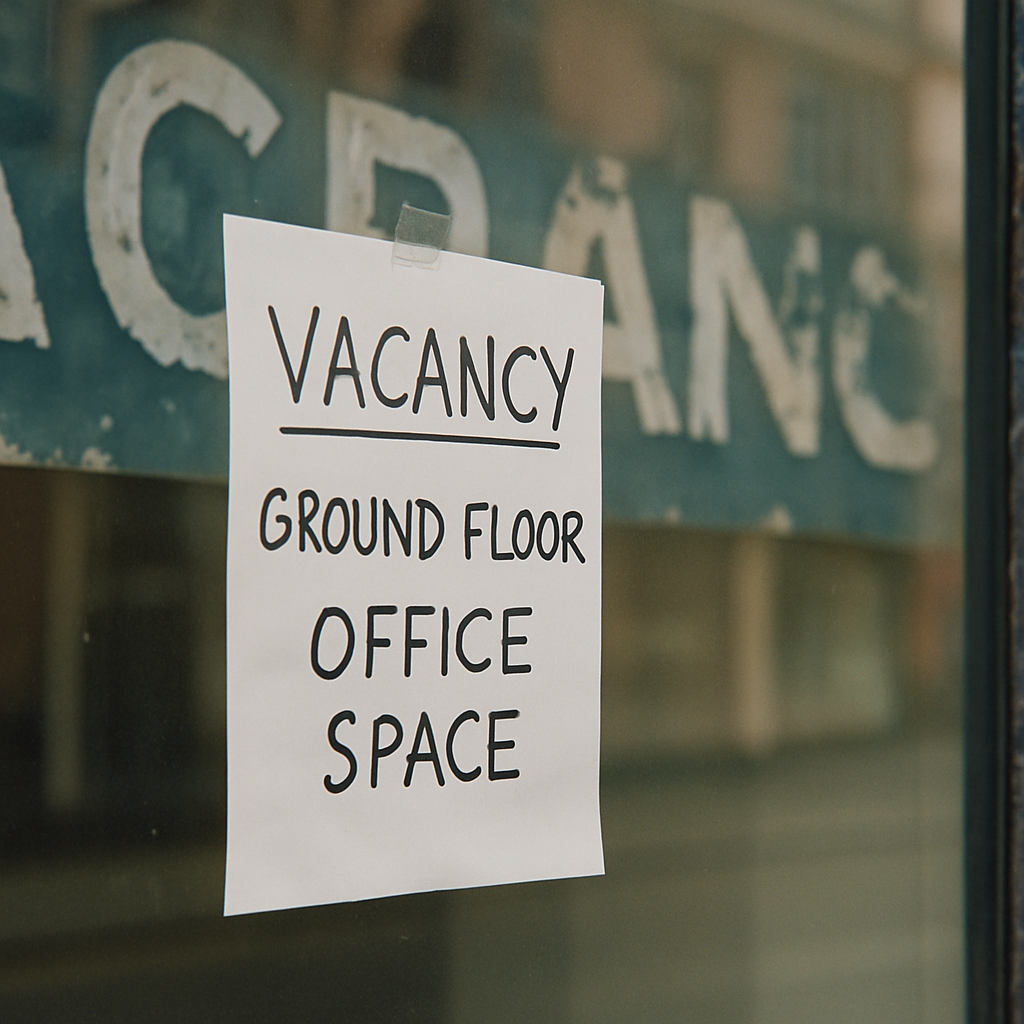
Occupancy data tells the story bluntly. According to research published by Savills and corroborated by data from the British Property Federation, average office utilisation across central London sits at roughly 40 to 50 per cent on any given weekday. Tuesday through Thursday see the highest footfall; Monday and Friday might as well be bank holidays for the average city-centre office. This is not a temporary blip. Lease renewal cycles are confirming it. Firms are downsizing their footprints at an extraordinary rate, taking less space, demanding higher quality, and simply walking away from anything built before 2010.

Why Office Occupancy Has Structurally Changed
The instinct is to blame remote working, and remote working certainly deserves its share of the credit. But that explanation flatters corporate leadership and misses the deeper forces at play. The truth is that the commercial real estate crisis was already brewing before March 2020. Technology had been quietly eroding the necessity of physical co-location for years. The pandemic simply compressed a decade of change into eighteen months.
What firms discovered was not that offices were unnecessary, but that they were over-provisioned. The standard of roughly one desk per employee, multiplied across vast open-plan floors, was a legacy of a world where presence was the only proxy for productivity. That world is gone. Most knowledge-economy employers now operate on the assumption that staff will be in the office two or three days a week. The arithmetic is brutal: if your workforce attends at 50 per cent capacity, you need roughly half the space. And in cities where prime office rents run at £70 to £100 per square foot per annum, half the space is a very appealing proposition.
What’s Happening to London’s Office Market Right Now
London’s commercial property market is experiencing stress at a scale not seen since the early 1990s. The City of London, Canary Wharf, and even parts of the West End are contending with rising vacancy rates, falling valuations, and a widening gulf between prime and secondary stock. Grade-A offices with excellent environmental credentials, flexible floor plates, and excellent transport links are still being let. Everything else is struggling.
Canary Wharf has become the most visible symbol of the commercial real estate crisis in Britain. HSBC’s decision to vacate its headquarters tower and consolidate into a smaller footprint in the City sent an unmistakable signal. The Wharf’s owners, the Canary Wharf Group, entered a debt restructuring process in 2024, and the long-term fate of several towers remains genuinely uncertain. This is not a peripheral story. It is happening at the heart of one of the world’s foremost financial districts.
Further afield, cities like Manchester, Birmingham, and Leeds are experiencing similar pressures, though the dynamics differ. Regional office markets never commanded the same rental premiums as London, which means the correction is less dramatic in headline terms but potentially more damaging to local authority finances that depend on business rates from commercial property. According to the ONS commercial property price statistics, capital values across the UK office sector have declined materially since 2022, with secondary stock bearing the sharpest losses.
The Investor Reckoning: Pension Funds and the Problem of Stranded Assets
For investors, the commercial real estate crisis raises questions that extend well beyond property portfolios. Pension funds, life insurers, and property investment trusts hold billions of pounds in office assets. Much of that was acquired at valuations reflecting a pre-2020 world of full occupancy and steady rental growth. Those valuations are being revised downward, sometimes sharply.
The concept of stranded assets, borrowed from climate finance, is increasingly useful here. A building that cannot be let because it fails modern sustainability requirements, lacks the flexibility tenants demand, or sits in a location that has simply lost its draw, is effectively stranded. It has a book value, but the market will not pay it. Investors holding these assets face an unpleasant choice: spend heavily on retrofit and repositioning, accept a heavily discounted sale, or wait and hope the market recovers. Most evidence suggests that waiting is not a strategy.
The same logic applies to lenders. UK banks and overseas institutions that provided debt against commercial property on generous terms during the low-interest-rate years of the 2010s are now staring at loan books where collateral values have deteriorated. The Bank of England has flagged commercial real estate as a source of financial stability risk in successive Financial Stability Reports. This is not alarmism. It is the quiet, measured language of institutional concern.
Could Conversion Be the Answer?
The obvious question, the one mayors, planners, and property developers all reach for, is whether redundant office buildings can be converted into housing. It is an appealing idea. Britain has a chronic housing shortage and a surplus of empty office space. Surely those two problems cancel each other out.
In practice, the arithmetic is considerably messier. Office floors designed for open-plan working often lack the structural depth, natural light penetration, and floor-to-ceiling height that residential conversions require. Central heating, plumbing, and fire safety standards for residential use are entirely different from commercial specifications. Many city-centre office blocks, particularly post-1960s curtain-wall buildings, are genuinely difficult and expensive to convert into habitable flats. Planning permissions add further complexity; permitted development rights allow some conversions without full planning consent, but local authorities in London and other major cities have frequently sought to restrict these rights to protect commercial land supply.
That said, successful conversions are happening. Former office blocks in Bristol, Leeds, and parts of east London have become residential schemes, sometimes with genuinely innovative design. The government’s recent push to streamline planning for office-to-residential conversion has added momentum. Firms managing these projects increasingly rely on digital tools to coordinate communications across large project teams, and even niche utilities like an email tester become useful when checking that stakeholder notification systems are working correctly across complex multi-party developments.
The City Centre Identity Crisis
Beyond the investment mathematics, the commercial real estate crisis poses a subtler but equally serious challenge: what is a city centre for, if not offices? The entire ecosystem of the urban core, sandwich shops, dry cleaners, coffee concessions, pubs at lunchtime, the whole fabric of weekday commercial life, was built around the assumption of mass daily commuting. Remove that critical mass of workers and the economic logic of the city centre begins to unravel.
This is already visible on the streets. Footfall data from the Centre for Cities think tank consistently shows that major UK city centres have not returned to pre-pandemic weekday pedestrian numbers. The recovery has been led by leisure and evening economy uses rather than work-related footfall. That is not necessarily fatal to city centres, but it requires a fundamental rethink of how urban space is programmed, funded, and maintained.
The commercial real estate crisis is, ultimately, a forcing function. It is obliging planners, investors, and politicians to ask questions about urban form that should have been asked decades ago. What kind of city do we want to build? How much space should be dedicated to work, to living, to culture, to nature? The answers will vary by place. But the era of the office monoculture, entire city blocks given over entirely to desk-based employment, is drawing to a close. What replaces it will define the next chapter of British urban life.
Frequently Asked Questions
Why are office vacancy rates so high in London right now?
Hybrid and remote working has permanently reduced the number of days employees attend offices, meaning firms need significantly less space than before. Many organisations are downsizing into smaller, higher-quality premises when leases expire, leaving older or less well-located buildings chronically underoccupied.
How does the commercial real estate crisis affect UK pension funds?
UK pension funds and property investment trusts hold significant allocations to office assets, many acquired at pre-2022 valuations. As capital values fall and rental income becomes less reliable, these funds face potential write-downs, reduced distributions, and difficult decisions about whether to sell, hold, or invest in expensive refurbishments.
Can empty office buildings in the UK be converted into housing?
Some can, but it is far from straightforward. Buildings designed for open-plan commercial use often have structural, lighting, and ventilation challenges that make residential conversion costly. Permitted development rights allow certain conversions without full planning consent, though London and several other councils have restricted these rights in designated commercial zones.
Which UK cities are most affected by falling office demand?
London, particularly Canary Wharf and parts of the City, has seen the most prominent distress, but Manchester, Birmingham, and Leeds are also contending with rising secondary vacancy rates. Regional cities face a different challenge in that their lower rental base leaves less room to absorb value declines without triggering loan covenant breaches.
What happens to local economies when office buildings empty out?
Reduced weekday footfall hits the surrounding retail and hospitality businesses that depend on lunchtime and commuter trade. Local authority income from business rates also falls as commercial property values decline, creating pressure on public services. Planners are increasingly looking at mixed-use redevelopment and evening economy incentives to compensate.