
There is a particular kind of institutional failure that only becomes visible once it is too late to manage cheaply. England’s school estate is a textbook example. Behind the painted murals and motivational posters, behind the acoustic ceiling tiles and the laminated behaviour charts, a significant proportion of the country’s state schools are quietly falling apart. The roof leaks. The boiler is held together by institutional hope and emergency callouts. And in the worst cases, the very concrete holding the building upright has been classified as a structural risk.
School estate disrepair is not a new problem. It is, however, a worsening one, and the political cost of confronting it honestly has proved too high for any successive government to bear. The result is a deferred reckoning that compounds interest with every passing year.
What the Department for Education’s Own Data Reveals
The Department for Education’s condition surveys make for sobering reading. The most comprehensive, published in 2021 and covering data gathered before the pandemic disrupted normal inspection cycles, estimated the cost of restoring England’s school buildings to a satisfactory condition at approximately £11.4 billion. Given that costs in the construction sector have risen sharply since, credible independent estimates now put the real figure closer to £15 billion. Some analysts believe it exceeds that considerably when you account for deferred maintenance that has deteriorated further since the survey was conducted.
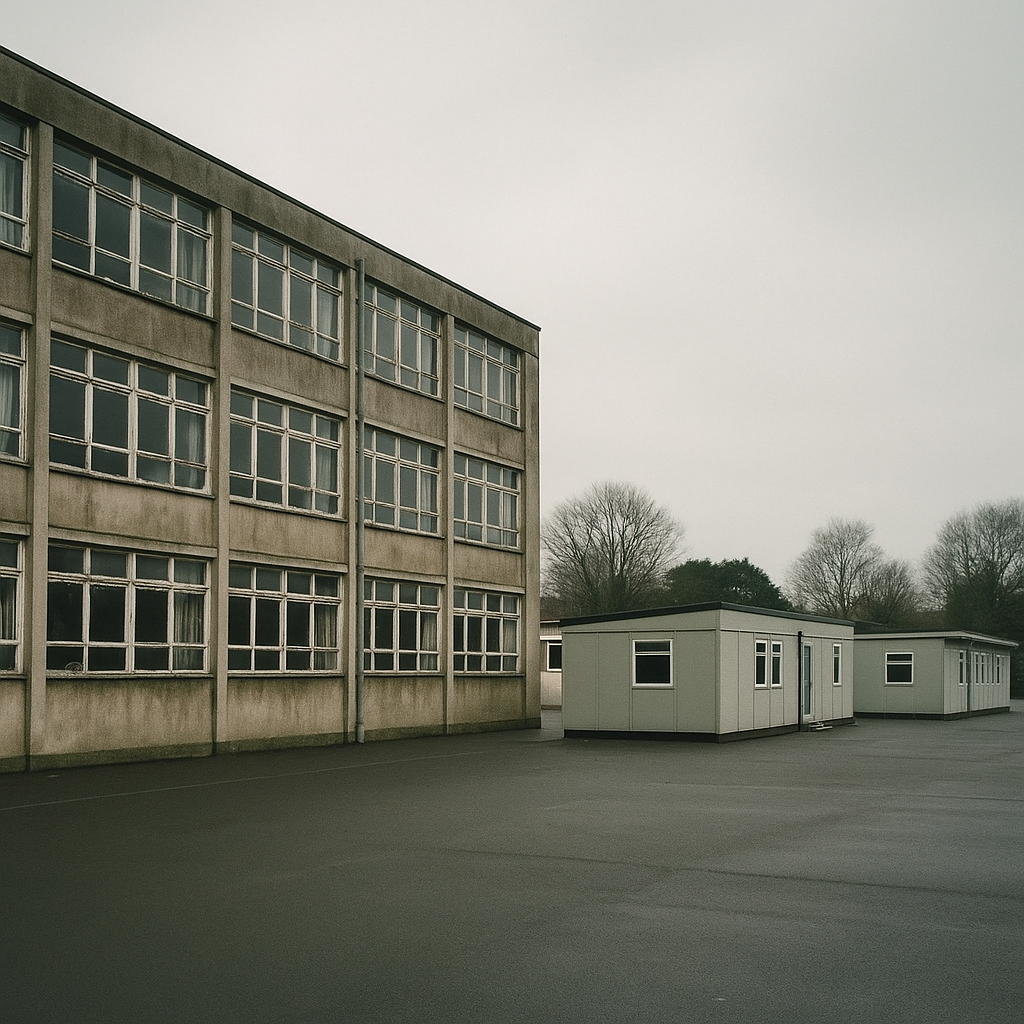
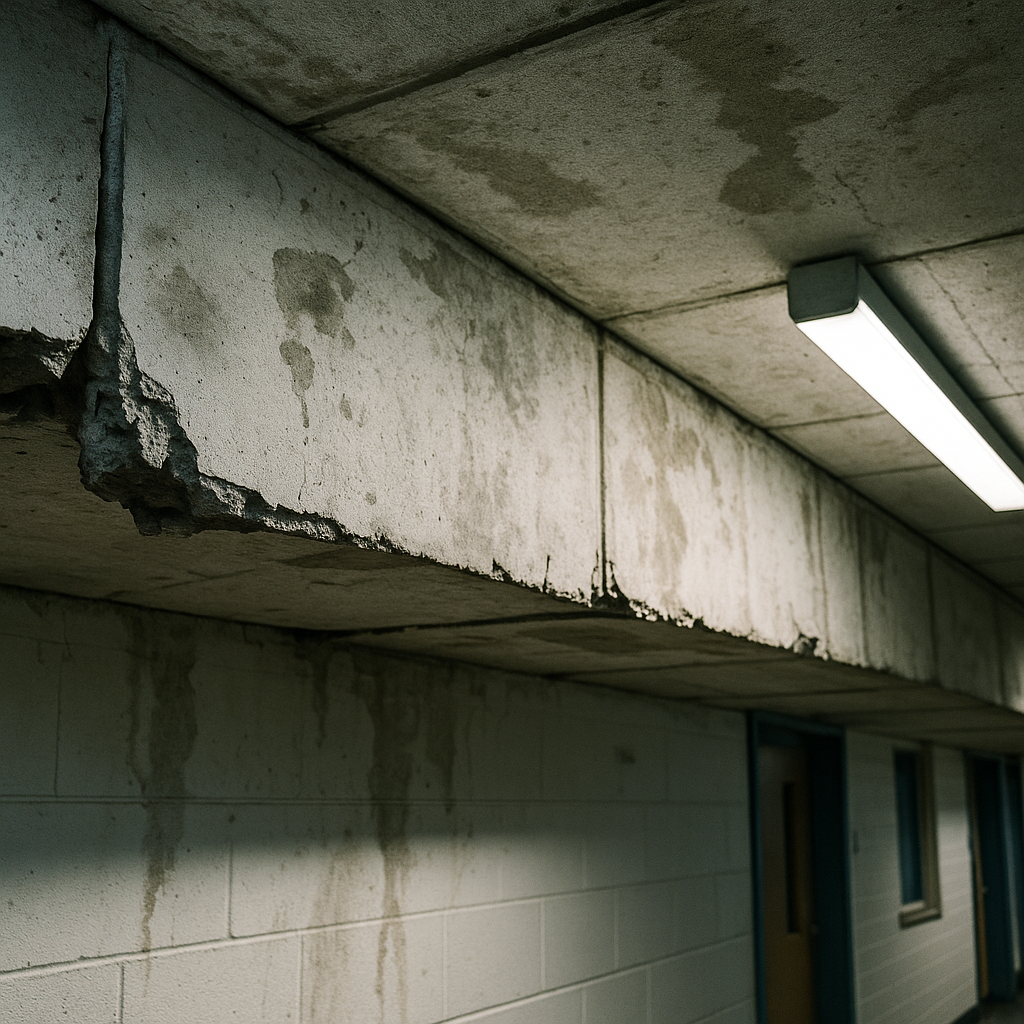
Roughly a third of the school estate was built between 1945 and 1975, during an era when speed of construction and volume of output mattered far more than longevity. Many of those buildings used materials and techniques that are now understood to be problematic. Reinforced Autoclaved Aerated Concrete, better known as RAAC, became the defining symbol of this crisis when it entered mainstream public consciousness in the summer of 2023. Lightweight, cheap to produce, and widely used in flat-roofed school buildings from the 1950s through to the 1980s, RAAC has a structural lifespan of roughly 30 years. Thousands of schools built with it are now well past that threshold.
The RAAC Scandal and What It Exposed
When the Department for Education confirmed in September 2023 that more than 150 schools contained RAAC panels deemed to pose an immediate risk of collapse, the public reaction was one of shock. The education sector’s reaction was rather more weary. Headteachers and building managers had been raising alarms about structural deterioration for years. What RAAC did was provide a single, visceral, media-friendly symbol for a crisis that had previously resisted easy narration.
Affected schools were forced to close classrooms, relocate pupils into temporary portacabins, or in some cases send children home entirely while emergency structural assessments were conducted. The disruption was significant. For pupils preparing for GCSEs or A-levels, losing access to familiar teaching environments mid-term is not a minor inconvenience; it is a measurable harm. For schools already managing post-pandemic learning recovery, the RAAC closures were another compounding blow.
Yet RAAC, for all its notoriety, represents only a fraction of the broader school estate disrepair picture. The government’s own school condition data identifies thousands of buildings with roofs in poor condition, inadequate heating systems, single-glazed windows, and electrical installations that fall below modern safety standards. These are not dramatic structural failures. They are the slow, grinding deterioration that makes learning harder, staff retention more difficult, and energy bills vastly higher than they should be.
How the Funding Gap Became Unfillable
Understanding how England arrived at this point requires a brief look at how school capital funding has worked, or rather has not worked, over the past two decades. Capital budgets for school maintenance were cut substantially during the austerity period following 2010. The Priority School Building Programme, launched to replace the most dilapidated buildings, was underfunded relative to the scale of need from the outset. Successive Spending Reviews have allocated sums that look meaningful in press releases but, when distributed across approximately 22,000 state-funded schools in England, amount to relatively modest per-school allocations.
Meanwhile, reactive maintenance costs have soared. When a boiler fails mid-January, a school cannot wait six months for a scheduled replacement. The emergency callout, the temporary heating units, the disruption to the school day: all of this costs money that was not in the budget, and it diverts funds from other priorities. The cruel arithmetic of deferred maintenance means that problems which could have been resolved for tens of thousands of pounds become hundreds-of-thousands-of-pound emergencies if left long enough.
The hidden hazards compound this further. Many older school buildings contain asbestos, a legacy of mid-twentieth century construction practices. Managing asbestos in situ, monitoring its condition, and ensuring that any building works do not disturb it, requires rigorous compliance procedures. Responsible duty holders commission professional asbestos sampling to establish the precise nature and condition of any asbestos-containing materials before works begin, an essential step that adds both cost and time to what might otherwise seem like a straightforward repair job. When budgets are tight, the temptation to delay even routine building works is strong; but in ageing schools, delay often transforms a manageable compliance task into a full remediation project.
The Human Cost: Pupils and Staff in Deteriorating Buildings
The infrastructure debate can feel abstract when discussed in terms of billions of pounds and condition survey categories. It becomes considerably less abstract when you consider what it is actually like to spend six hours a day in a building with no effective heating in February, or to try to concentrate on revision in a classroom where rainwater drips steadily into a strategically placed bucket.
Research consistently demonstrates that the physical learning environment affects both academic outcomes and mental wellbeing. A 2015 study by the University of Salford, tracking 3,766 pupils across 27 primary schools, found that physical classroom conditions including air quality, natural light, and temperature accounted for 16 per cent of the variation in pupil academic progress over a single year. Extrapolated across years of schooling in a substandard building, the cumulative effect on outcomes is significant.
For teachers, the situation is equally corrosive. Staff retention is already a serious issue in English state schools, with the government’s own data showing that a meaningful proportion of new teachers leave the profession within five years. Working in a building where the facilities are inadequate, where the cold gets into your bones by October, and where you are constantly navigating the logistics of a leaking or structurally compromised workspace, does not encourage anyone to stay.
Why This Problem Keeps Getting Inherited Rather Than Solved
The politics of school estate disrepair are, in their own way, instructive. The costs of fixing the problem are immediate, visible, and enormous. The benefits are diffuse, long-term, and politically unglamorous. No government gets a significant polling bounce from replacing a flat roof in Rotherham or rewiring an ageing secondary school in Wolverhampton. The infrastructure investment that prevents a crisis generates no headlines; only the crisis itself does.
This creates a structural incentive to defer. Each administration inherits a problem slightly worse than the one before it, announces a programme that addresses the most acute cases, and hopes that the underlying deterioration does not accelerate to scandal during its tenure. RAAC proved that this strategy has limits. At some point, the deferral catches up with you in a way that cannot be managed quietly.
The current government has pledged to rebuild or significantly refurbish 518 schools over the coming decade under the School Rebuilding Programme. The ambition is genuine. Whether the pace is sufficient, given the scale of deterioration across the wider estate, remains deeply contested by sector bodies including the National Audit Office, which has previously noted that the programme’s timescales are optimistic relative to historical delivery rates.
What a Genuine Solution Would Require
Serious engagement with school estate disrepair demands a multi-year, ring-fenced capital commitment that is insulated from short-term Spending Review pressures. It requires a credible national survey conducted regularly rather than sporadically, so that condition data is current enough to be actionable. And it requires political honesty about the scale of what is needed, rather than the announcement of programmes calibrated to sound impressive at a press conference whilst addressing a fraction of the real need.
England’s children do not choose the buildings they learn in. They do not choose whether the roof holds or the heating works or the structure above them is sound. Those choices belong to politicians, and for decades the choices made have been to look away. The bill for looking away keeps growing. At some point, the only question left will be how much more expensive inaction was than action would have been.
Frequently Asked Questions
How many schools in England are affected by RAAC concrete?
As of the Department for Education’s most recent assessments, over 200 schools have been confirmed to contain RAAC panels, with more than 150 initially identified as posing an immediate structural risk. The full picture is still emerging as surveys of older flat-roofed buildings continue.
What is the estimated cost to fix England's school building crisis?
The DfE’s 2021 condition survey put the cost of restoring the school estate to a satisfactory standard at around £11.4 billion, though more recent estimates accounting for construction inflation place the figure closer to £15 billion or above. The gap between available funding and identified need remains very substantial.
Does poor school building condition actually affect pupils' results?
Yes, there is credible research linking physical classroom conditions to academic outcomes. A major University of Salford study found that factors including air quality, temperature, and natural light accounted for roughly 16 per cent of variation in pupil progress, suggesting that learning environments have a measurable and meaningful impact.
What is the School Rebuilding Programme and how many schools does it cover?
The School Rebuilding Programme is a government initiative to rebuild or significantly refurbish schools in the worst condition across England, with 518 projects currently pledged. However, the National Audit Office has questioned whether delivery timescales are realistic, and critics argue the programme does not address the breadth of the wider estate’s needs.
Why do older school buildings pose asbestos risks during repairs?
Many schools constructed between the 1940s and 1980s incorporated asbestos-containing materials in insulation, ceiling tiles, and pipe lagging. When those buildings undergo refurbishment or repair, any disturbance of these materials can release dangerous fibres, meaning that compliant surveying and testing must be completed before works begin.