
The government’s gigabit broadband target was, on paper, one of the more ambitious infrastructure pledges of recent years: full-fibre connectivity to at least 85% of UK premises by the end of 2025, with gigabit-capable broadband reaching virtually everywhere shortly after. Ofcom’s own Connected Nations report now gives us a clear-eyed account of how that promise is holding up. The short answer is: well enough if you live in a city, and not at all if you do not.
The UK full fibre broadband rollout 2026 has genuinely accelerated. Full-fibre coverage now reaches around 60% of UK premises, up from a dismal 8% in 2019. That is real progress, and credit belongs partly to the competitive market that emerged when alternative network builders, known as altnets, piled into profitable urban territories. But acceleration in aggregate obscures a deeply uneven geography. The question that matters is not how fast the national average is moving; it is who remains on the wrong side of it.
What Ofcom’s data actually shows
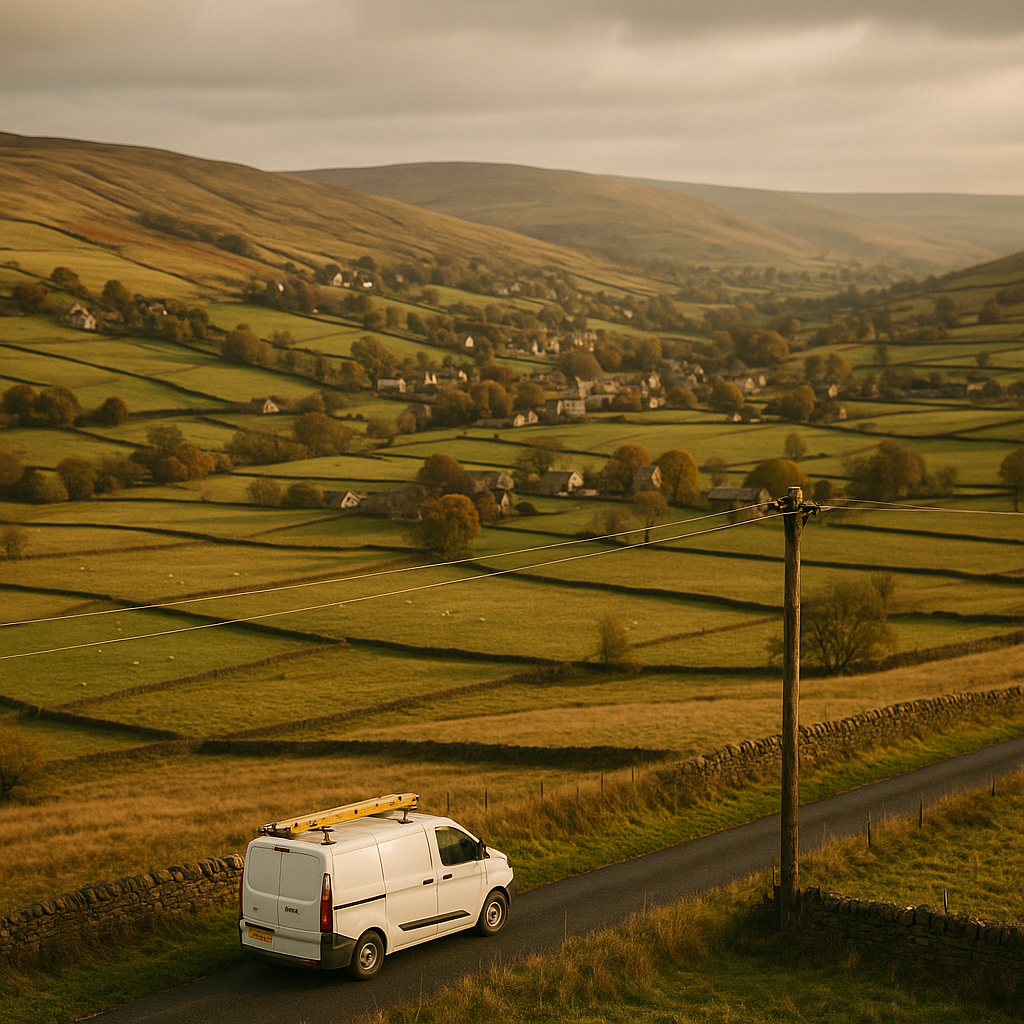
Ofcom’s Connected Nations data for 2025 makes for uncomfortable reading if you happen to live in rural England, Scotland, Wales or Northern Ireland. In some rural areas of Wales, full-fibre availability sits below 30%. Parts of rural Scotland fare similarly. Northern Ireland has the highest overall gigabit-capable coverage in the UK, largely because of the publicly funded Project Stratum, which is itself a revealing detail. State intervention works where markets will not go.
Urban pockets also suffer, though in different ways. Dense blocks of flats in cities like Birmingham and Leeds frequently have gigabit-capable infrastructure passing the building but no operator willing to fund the internal wiring needed to connect individual flats. Coverage maps mark these premises as served. In practice, the residents cannot get a full-fibre connection at any price. Ofcom’s own methodology counts a premises as covered if fibre passes nearby, which leads to statistics that are flattering to everyone except the person trying to work from home on a failing copper line.
Why the commercial model is failing rural Britain
The government’s strategy rested on a reasonable assumption: competitive commercial markets would drive rollout in profitable areas, while the £5 billion Project Gigabit programme would fund the rest through public subsidy contracts. The problem is that the boundary between commercially viable and commercially unviable has proved far more hostile than anticipated.
Laying fibre to a village of 200 homes in Cumbria or Ceredigion costs roughly the same per property as connecting an urban terrace, but the revenue potential is a fraction of the size. Altnets, companies such as Cityfibre, Toob, and Gigaclear, have largely concentrated their capital in cities and market towns where return on investment is calculable. BT’s Openreach, to its credit, has pushed further into rural territory than most, but even Openreach has acknowledged that a meaningful percentage of UK premises will never be commercially attractive to any operator without subsidy.
Project Gigabit contracts have been signed, and some rural communities in Devon, Lincolnshire and the Scottish Borders are finally seeing engineers at work. But the procurement process has been slow, marked by rebidding and delays that have pushed realistic completion dates well into the late 2020s for many areas. Some communities awarded contracts in 2022 are still waiting for a spade to enter the ground.
The people who need it most are being served last
The cruel irony of the UK full fibre broadband rollout 2026 is that the communities least well served are often those for whom reliable connectivity matters most acutely. Rural households and businesses are frequently more dependent on remote working than their urban counterparts, not by lifestyle choice but by necessity. A farmer managing procurement through an online livestock marketplace, a GP surgery attempting to run remote consultations via NHS Digital systems, a secondary school in a market town delivering hybrid lessons, all of them are operating on infrastructure designed for a different era.
The economic consequences compound over time. The haemorrhage of skilled workers to better-connected locations is partly a broadband story. Young professionals who might otherwise remain in rural communities leave not because they dislike them but because working from a cottage in Yorkshire on a 15 Mbps ADSL connection is simply not viable in a world that expects Teams calls, cloud collaboration and video pitching as a baseline. Poor connectivity is a quiet accelerant to depopulation.
Altnets in crisis, and what that means for coverage ambitions
There is a further complication that barely featured in the government’s original projections. Many of the altnets that were supposed to compete Openreach into efficiency have run into serious financial difficulty. Smaller operators have consolidated, been acquired, or quietly stopped building. The altnet funding model depended on cheap capital and investor appetite that has thinned considerably as interest rates rose. Several prominent players have restructured their debt or paused rollout in 2025 and 2026, leaving behind partially built networks that serve some streets in a postcode but not others.
This creates a new class of underserved premises: not remote farmhouses beyond the commercial frontier, but ordinary streets in provincial towns where a network was started and then stopped. Residents are sometimes unable to switch because a half-built altnet network has been registered as covering their address, deterring other operators from investing in the same area. The duplication of infrastructure in wealthy neighbourhoods alongside abandonment elsewhere has produced a market that is structurally inefficient in ways that were entirely foreseeable.
The situation echoes broader questions about what happens when public services are left to market logic alone. Much as NHS dentistry has retreated from the areas that need it most because the funding model simply does not follow patient need, broadband infrastructure follows revenue rather than necessity. The parallel is uncomfortable but exact.
What a genuine solution would require
Universal service obligations exist in telecoms, BT is legally required to provide a connection of at least 10 Mbps to any premises that requests one, but 10 Mbps is an embarrassingly low floor in 2026. The government’s own £1 Gigabit Broadband Voucher Scheme, which offered households and businesses in eligible rural areas up to £4,500 towards connection costs, was oversubscribed almost immediately and has suffered repeated funding gaps. Demand exists. The money and the delivery mechanisms have not kept pace with it.
Properly solving rural connectivity requires either a much larger and faster-moving Project Gigabit programme, or a radical revision of the universal service obligation to reflect what the digital economy actually demands. Some analysts advocate a model closer to the electricity grid: a regulated national wholesale infrastructure, with commercial operators competing on services rather than on who builds pipe to which postcode. The political appetite for that level of intervention has historically been low, though the gap between rhetoric and delivery is making the conversation unavoidable.
The UK full fibre broadband rollout 2026 is, in aggregate, a genuine achievement. Millions of premises now have access to speeds unimaginable fifteen years ago. But aggregate statistics have a way of hiding the specific, named communities that remain on the wrong side of every chart. For them, the rollout has not moved slowly. It has not come at all. That distinction matters, and it deserves to be said plainly rather than smoothed into a national average.
Meanwhile, broader questions about how Britain builds and funds essential infrastructure, from school buildings falling apart to fibre cables that stop at the edge of a profitable postcode, are accumulating into something that looks less like a series of isolated failures and more like a governing philosophy that has reached its limits.