
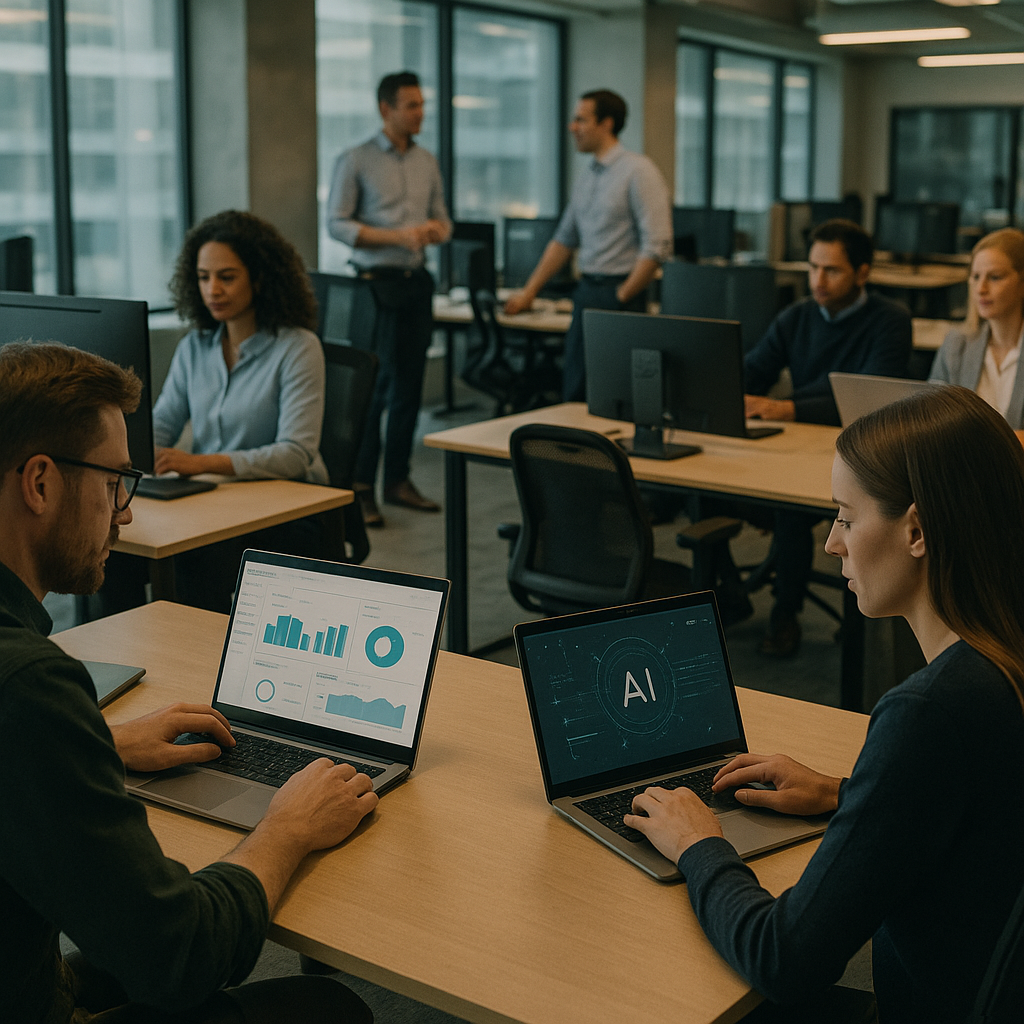
AI in the workplace has moved from experiment to everyday reality, often without the fanfare one might expect. The most striking change is that it is no longer confined to specialist teams. It is quietly embedded in calendars, inboxes and HR systems, reshaping how decisions are made and how work feels.

What AI in the workplace actually looks like now
For most professionals, the first encounter with this technology is unglamorous: meeting transcripts that appear automatically, suggested email replies, and scheduling tools that anticipate preferences. These small frictions being removed at scale can alter the rhythm of an entire organisation.
In many offices, AI tools are starting to summarise lengthy reports, flag anomalies in spreadsheets and even draft the first version of client presentations. Rather than replacing roles outright, they are shaving hours from the more mechanical parts of the day, allowing people to focus on interpretation, judgement and relationships.
Behind the scenes, finance teams are using predictive models to forecast cash flow with greater precision, while operations teams lean on algorithms to spot bottlenecks before they become visible to the human eye. The effect is subtle but profound: fewer surprises, more data and a constant pressure to justify decisions.
How AI in the workplace is reshaping meetings and communication
Meetings are often the most visible frontier. Automatic transcription, real-time translation and live action points are becoming standard in larger firms. A quiet revolution is under way: the focus is shifting from note-taking to genuine discussion.
When every word is recorded and converted into searchable text, the culture of meetings changes. It becomes harder to rely on vague recollections or informal agreements. Clarity improves, but so does the sense of scrutiny. Leaders need to think carefully about when such tools are appropriate, and when a conversation should remain off the record.
Internal communication platforms are also being reshaped. AI-driven assistants are fielding routine HR questions, guiding staff through policies and even suggesting learning resources based on role and performance. The line between knowledge base and colleague is becoming blurred.
Ethics, bias and trust in AI in the workplace
The ethical questions are no longer theoretical. Recruitment platforms can scan thousands of CVs in minutes, but they can also entrench bias if they learn from historical hiring data. Performance tools can flag underperformance early, yet risk reducing complex human stories to a single score.
Trust is now a strategic asset. Employees increasingly want to know which decisions are being influenced by algorithms, what data is being collected and how it is being used. Clear governance, transparent policies and the ability to contest automated decisions are fast becoming minimum expectations rather than luxuries.
Forward-looking organisations are involving staff in the design and rollout of new systems, inviting feedback and stress-testing tools before they touch sensitive processes such as promotion or pay. The aim is to use AI as a decision support layer, not an unquestioned authority.
Preparing people and processes for the next wave
The most successful adopters treat AI as an organisational capability rather than a gadget. That means investing in training, redesigning workflows and setting clear boundaries on where automation stops. It also means accepting that some roles will evolve significantly.
Professionals are being nudged towards new skill sets: data literacy, critical thinking, prompt crafting, and a more rigorous approach to checking sources. The value of domain expertise is rising, not falling, as staff are asked to interpret machine-generated outputs and push back when something feels wrong.
Specialist consultancies such as ACS are increasingly being asked to audit existing tools, map out where automation genuinely helps, and where it simply adds complexity. The emphasis is on building quiet, dependable systems rather than headline-grabbing experiments.
What leaders should do now
For leaders, the task is to set a thoughtful pace. That starts with a clear view of where AI genuinely supports the organisation’s goals, rather than adopting tools because competitors have done so. Pilots should be small, measurable and reversible.
 Business leader discussing strategy using analytics from AI in the workplace” style=”display:block;width:100%;height:auto;max-width:1000px;margin:0 auto;”>
AI in the workplace FAQs
Will AI in the workplace replace my job entirely?
Most current deployments of AI in the workplace focus on automating specific tasks rather than whole roles. Routine, repetitive work is likely to change the most, while activities involving judgement, relationships and creativity remain firmly human. Roles will evolve, with more emphasis on overseeing, interpreting and challenging machine-generated outputs.
How can companies introduce AI in the workplace without losing employee trust?
Trust depends on transparency and participation. Organisations should be clear about what tools are being used, what data they rely on and which decisions they influence. Involving staff in pilots, inviting feedback and offering training all help. Crucially, employees should retain the right to question or appeal outcomes that rely heavily on automated systems.
What skills should I develop to stay relevant as AI in the workplace grows?
It is useful to build confidence with data, learn how to structure good questions for AI tools and strengthen critical thinking. Domain expertise remains vital, as does the ability to communicate clearly and work with others. Those who can combine technical fluency with sound judgement and ethical awareness will be particularly well placed.
Leave a Reply