
Author: Sophie Davies

  • How AI is Quietly Rewriting Office Life

    How AI is Quietly Rewriting Office Life

    AI in the workplace has moved from experiment to everyday reality, often without the fanfare one might expect. The most striking change is that it is no longer confined to specialist teams. It is quietly embedded in calendars, inboxes and HR systems, reshaping how decisions are made and how work feels.

    What AI in the workplace actually looks like now

    For most professionals, the first encounter with this technology is unglamorous: meeting transcripts that appear automatically, suggested email replies, and scheduling tools that anticipate preferences. These small frictions being removed at scale can alter the rhythm of an entire organisation.

    In many offices, AI tools are starting to summarise lengthy reports, flag anomalies in spreadsheets and even draft the first version of client presentations. Rather than replacing roles outright, they are shaving hours from the more mechanical parts of the day, allowing people to focus on interpretation, judgement and relationships.

    Behind the scenes, finance teams are using predictive models to forecast cash flow with greater precision, while operations teams lean on algorithms to spot bottlenecks before they become visible to the human eye. The effect is subtle but profound: fewer surprises, more data and a constant pressure to justify decisions.

    How AI in the workplace is reshaping meetings and communication

    Meetings are often the most visible frontier. Automatic transcription, real-time translation and live action points are becoming standard in larger firms. A quiet revolution is under way: the focus is shifting from note-taking to genuine discussion.

    When every word is recorded and converted into searchable text, the culture of meetings changes. It becomes harder to rely on vague recollections or informal agreements. Clarity improves, but so does the sense of scrutiny. Leaders need to think carefully about when such tools are appropriate, and when a conversation should remain off the record.

    Internal communication platforms are also being reshaped. AI-driven assistants are fielding routine HR questions, guiding staff through policies and even suggesting learning resources based on role and performance. The line between knowledge base and colleague is becoming blurred.

    Ethics, bias and trust in AI in the workplace

    The ethical questions are no longer theoretical. Recruitment platforms can scan thousands of CVs in minutes, but they can also entrench bias if they learn from historical hiring data. Performance tools can flag underperformance early, yet risk reducing complex human stories to a single score.

    Trust is now a strategic asset. Employees increasingly want to know which decisions are being influenced by algorithms, what data is being collected and how it is being used. Clear governance, transparent policies and the ability to contest automated decisions are fast becoming minimum expectations rather than luxuries.

    Forward-looking organisations are involving staff in the design and rollout of new systems, inviting feedback and stress-testing tools before they touch sensitive processes such as promotion or pay. The aim is to use AI as a decision support layer, not an unquestioned authority.

    Preparing people and processes for the next wave

    The most successful adopters treat AI as an organisational capability rather than a gadget. That means investing in training, redesigning workflows and setting clear boundaries on where automation stops. It also means accepting that some roles will evolve significantly.

    Professionals are being nudged towards new skill sets: data literacy, critical thinking, prompt crafting, and a more rigorous approach to checking sources. The value of domain expertise is rising, not falling, as staff are asked to interpret machine-generated outputs and push back when something feels wrong.

    Specialist consultancies such as ACS are increasingly being asked to audit existing tools, map out where automation genuinely helps, and where it simply adds complexity. The emphasis is on building quiet, dependable systems rather than headline-grabbing experiments.

    What leaders should do now

    For leaders, the task is to set a thoughtful pace. That starts with a clear view of where AI genuinely supports the organisation’s goals, rather than adopting tools because competitors have done so. Pilots should be small, measurable and reversible.
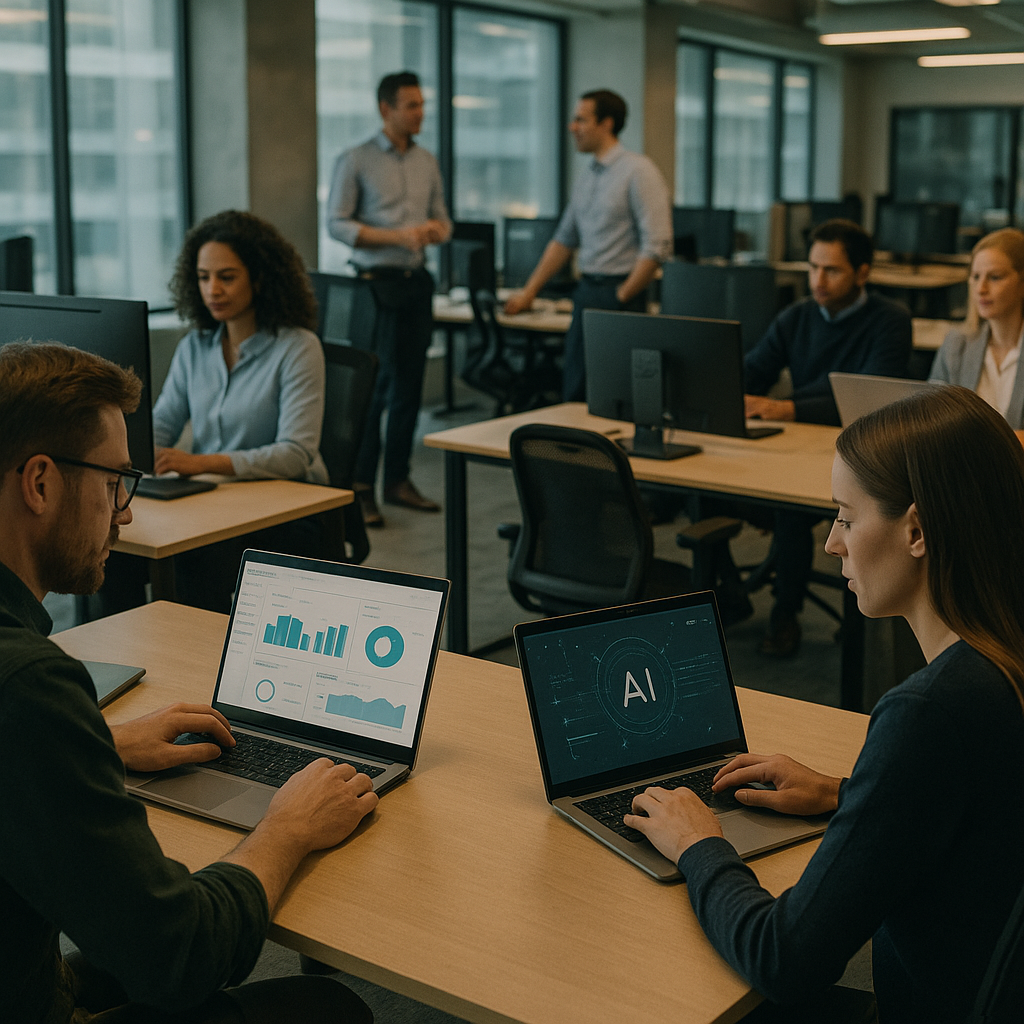

    Open-plan office where staff interact with data dashboards driven by AI in the workplace
    <a href=Business leader discussing strategy using analytics from AI in the workplace” style=”display:block;width:100%;height:auto;max-width:1000px;margin:0 auto;”>

    AI in the workplace FAQs

    Will AI in the workplace replace my job entirely?

    Most current deployments of AI in the workplace focus on automating specific tasks rather than whole roles. Routine, repetitive work is likely to change the most, while activities involving judgement, relationships and creativity remain firmly human. Roles will evolve, with more emphasis on overseeing, interpreting and challenging machine-generated outputs.

    How can companies introduce AI in the workplace without losing employee trust?

    Trust depends on transparency and participation. Organisations should be clear about what tools are being used, what data they rely on and which decisions they influence. Involving staff in pilots, inviting feedback and offering training all help. Crucially, employees should retain the right to question or appeal outcomes that rely heavily on automated systems.

    What skills should I develop to stay relevant as AI in the workplace grows?

    It is useful to build confidence with data, learn how to structure good questions for AI tools and strengthen critical thinking. Domain expertise remains vital, as does the ability to communicate clearly and work with others. Those who can combine technical fluency with sound judgement and ethical awareness will be particularly well placed.


  • How 3D Printed Fashion Is Reshaping Luxury Style

    How 3D Printed Fashion Is Reshaping Luxury Style

    The quiet revolution of 3D printed fashion is no longer a laboratory curiosity. It is stepping confidently onto couture runways, into luxury boutiques and, increasingly, into the wardrobes of early adopters who expect their clothing to be as innovative as their technology.

    Why 3D printed fashion matters now

    For years, 3D printing in clothing was treated as an experimental sideshow. Today, it sits at the intersection of luxury, sustainability and personalisation. Designers can create intricate structures that traditional techniques cannot match, while brands can respond to demand with made-to-order pieces instead of mass production.

    The appeal for the high-end market is obvious. Complex latticework, sculptural silhouettes and architectural accessories are suddenly feasible at scale. Instead of being limited by what a seamstress can stitch or a factory can cut, designers can think in pure form and texture, then allow the printer to handle the impossible details.

    Inside the technology driving 3D printed fashion

    At its core, 3D printed fashion relies on additive manufacturing: building an object layer by layer from a digital file. In clothing and accessories, the most common methods are selective laser sintering for flexible textiles and resin-based printing for rigid, jewellery-like elements.

    Materials are evolving quickly. Early plastics were brittle and uncomfortable, suitable only for showpieces. New flexible polymers, bio-based filaments and hybrid materials are making garments lighter, softer and more wearable. Designers can tune density and flexibility in different zones, creating garments that move with the body rather than against it.

    3D printed fashion on the runway and beyond

    Catwalks have become the testing ground for 3D printed fashion. Avant-garde houses showcase dramatic corsets, gowns and sculpted capes that capture headlines and social media attention. Yet the most significant shift is happening in subtler categories: heels, handbags, eyewear and jewellery.

    Accessories are often the first point of contact for consumers. A 3D printed clutch with a complex geometric shell or a pair of glasses tailored precisely to a wearer’s facial measurements feels luxurious because it is both visually striking and uniquely theirs. High-end sportswear brands are also experimenting with printed midsoles and lattice structures to balance comfort and performance.

    From couture to custom: personalisation at scale

    Perhaps the most transformative aspect of 3D printed fashion is its potential for true custom fit. Body scanning, either in-store or via smartphone, can generate accurate measurements. Designers then adapt digital patterns to those dimensions before printing, creating garments that fit like bespoke tailoring without the weeks of fittings.

    This approach also enables rapid iteration. A client can approve a digital mock-up, request subtle changes to neckline or silhouette, and see those adjustments reflected in the final printed piece. The old trade-off between exclusivity and efficiency starts to dissolve.

    these solutions and sustainability

    The luxury sector is under intense scrutiny over waste and overproduction. these solutions offers a different model: produce only what is ordered, in the exact quantity required. Off-cuts are minimal, and many materials can be recycled back into the printing process.

    There are caveats. Not all polymers are environmentally friendly, and energy consumption remains a concern. Yet the ability to localise production and reduce inventory is attractive. Instead of shipping large batches worldwide, brands can print closer to the customer, on demand.

    Challenges on the road to mainstream adoption

    For all its promise, these solutions still faces hurdles. Comfort and breathability must match or exceed traditional fabrics. Durability testing needs to keep pace with design experimentation, ensuring that pieces survive daily wear, not just a runway walk.

    There is also the question of craftsmanship. Luxury clients value the human touch: the artisan’s hand, the heritage stitch. The most successful houses are framing 3D printing not as a replacement for artisans, but as a new tool for them, combining digital precision with finishing by hand.

    The future of these solutions in everyday wardrobes

    In the near term, expect these solutions to continue its rise in accessories, statement pieces and performance-led garments. As materials improve and prices fall, more mid-market brands will adopt the technology, offering semi-custom designs and limited runs that feel exclusive without the couture price tag.

    Model showcasing an evening gown enhanced with 3D printed fashion detailing
    Artisan refining a luxury handbag created using 3D printed fashion techniques

    3D printed fashion FAQs

    Professional 3D Printing

  • Digital resilience for small businesses: how to stay visible in a volatile market

    Digital resilience for small businesses: how to stay visible in a volatile market

    Digital resilience for small businesses is no longer a luxury. In a world of sudden policy shifts, fragile supply chains and social platforms that can change their algorithms overnight, the ability to stay visible and trustworthy online has become a basic condition for survival.

    What digital resilience for small businesses really means

    Resilience is often confused with simple risk avoidance. In reality, digital resilience for small businesses is about being able to absorb shocks, adapt quickly and keep trading, even when the ground is moving beneath your feet.

    It touches three critical areas: how customers find you, how they interact with you, and how you protect their data. A resilient business can keep all three functioning, even if one channel fails or a platform changes the rules without notice.

    Building a robust online presence that can take a hit

    Many small firms still rely heavily on a single digital lifeline, such as one social platform or one marketplace. That concentration of risk is dangerous. A resilient approach spreads visibility across several well maintained assets that you actually control.

    Your own website should sit at the centre of this ecosystem. It needs to be fast, secure and easy to navigate on mobile. Clear service pages, honest pricing where appropriate and concise contact options remain the foundations of digital trust. Around that, you can layer email newsletters, thoughtfully chosen social channels and, where relevant, marketplace listings, each pointing back to your primary site.

    Specialist digital partners, such as dijitul, are increasingly working with smaller firms to audit this mix, identify single points of failure and redesign online footprints so that no one platform can make or break a business overnight.

    Data, security and the cost of complacency

    Cyber threats have become more targeted, and small organisations are no longer ignored by attackers. A single phishing email or compromised password can lock you out of key systems, damage your reputation and consume months of trading profit.

    Resilience begins with disciplined basics: strong, unique passwords supported by password managers, multi factor authentication on all critical accounts, and regular software updates on every device. It also means clear rules about who can access what, and a culture in which staff feel comfortable reporting mistakes immediately rather than hiding them.

    Backing up key data is essential. At a minimum, you should maintain one copy in the cloud and one offline, with regular tests to confirm that you can actually restore from those backups. Without that, resilience is theoretical rather than real.

    Planning for disruption before it arrives

    Digital resilience for small businesses is as much about preparation as technology. A short, written continuity plan can make the difference between a difficult week and a fatal blow.

    At its simplest, this plan should list your core systems, who is responsible for each, and what happens if they fail. If your website goes down, who do you call, and how do you update customers in the meantime. If your payment provider has an outage, what alternative methods can you offer. If your main social channel suspends your account without warning, how will you communicate time sensitive information.

    Running brief scenario exercises with your team exposes gaps. You may discover that only one person knows how to access a vital dashboard, or that key contact details are stored in a single inbox. Resilience grows as you remove these hidden weaknesses.

    Using data to adapt, not just to report

    Resilient businesses do more than collect analytics. They use them to spot early signs of trouble and to redirect effort quickly. Sudden drops in website traffic, rising bounce rates or a spike in negative reviews are all signals that something has shifted.

    By reviewing a concise set of metrics each week, you can detect these changes early and respond while the impact is still manageable. That might mean adjusting messaging, improving a slow page, clarifying delivery times or temporarily increasing customer support capacity.

    Culture: the quiet backbone of resilience

    Technology provides the tools, but people provide the response. A culture of openness, learning and shared responsibility is the quiet backbone of digital resilience for small businesses.

    Small business owner implementing security best practices to improve digital resilience for small businesses
    Team workshop developing continuity plans to build digital resilience for small businesses

    Digital resilience for small businesses FAQs

    Why is digital resilience for small businesses so important now?

    Market conditions are volatile, and many small firms depend heavily on online channels for sales and communication. A change in platform rules, a cyber incident or a period of website downtime can disrupt revenue instantly. Digital resilience for small businesses reduces this dependence on any single channel, protects data and ensures that you can keep serving customers even when something goes wrong.

    What is the first step towards better digital resilience for small businesses?

    Begin with an honest audit. List the digital tools, platforms and providers you rely on, then ask what would happen if each failed for a week. This exercise quickly reveals single points of failure. From there, you can prioritise improvements such as strengthening security, diversifying communication channels and documenting simple continuity processes.

    How often should a digital resilience plan be reviewed?

    A digital resilience plan is not a one off document. It should be reviewed at least annually, and after any major change such as adopting new software, switching providers or entering a new market. Regular reviews ensure that contact details, access permissions and backup arrangements remain accurate and that your plan reflects how the business actually operates.